ROI on Continuous Penetration Testing (CPT)

ROI on Continuous Penetration Testing (CPT): Annual Penetration Testing Is Failing Modern Security Programs
The cyber threat landscape has never been more unforgiving. Attackers operate with relentless speed, automation, and creativity. They move fluidly between digital entry points and escalate privileges in hours or days, not months. Meanwhile, most organizations still approach their offensive security posture as if the world is frozen in time: one annual penetration test, a remediation spreadsheet, maybe a re-test before an audit, and then silence until the next year. This model made sense a decade ago. Today, it represents one of the largest systemic weaknesses in cybersecurity programs across every industry.
Continuous penetration testing isn’t merely an upgrade to the traditional model, it’s a paradigm shift. It aligns security operations with real-world adversary behavior, reduces risk at a faster rate, and offers measurable business ROI that extends far beyond technical remediation. The companies that embrace it discover that the real value is not more testing, but more time in control, less time exposed, less time breached, and less time in reactive firefighting mode.
This article explores the key drivers of ROI behind continuous penetration testing, why annual penetration tests introduce hidden costs, and how proactive offensive validation dramatically improves risk posture, decision-making, and operational resilience.
The Hidden Flaw: Why Annual Penetration Testing Fail in Modern Threat Environments
Organizations justify annual penetration tests for three reasons: compliance, budget predictability, and tradition. Security leaders have been conditioned to treat penetration testing like insurance paperwork, required, episodic, non-operational.
Yet this approach is fundamentally mismatched to attacker behavior.
A typical annual penetration tests produces a snapshot: a point-in-time view of exploitable attack paths and weaknesses. Even if the test is comprehensive, the moment the assessment ends, the environment begins to drift away from what was tested:
- New assets and APIs are deployed.
- Third parties introduce vulnerabilities.
- Internal misconfigurations occur.
- Cloud services change defaults.
- Emerging exploit techniques appear that did not exist when tested.
Within days or weeks, the real environment that attackers see no longer resembles the system that was assessed—creating a widening blind spot. The result? Organizations feel secure, while attackers see open windows.
This gap is precisely what adversaries exploit. Ransomware groups, criminal syndicates, and state-aligned threat actors don’t wait for your next annual test; they probe constantly. They monitor how quickly vulnerabilities are discovered and how long they remain unpatched. Opportunistic scanning tools have automated what used to require manual reconnaissance. When annual assessments introduce 90–180 day detection delays, attackers gain strategic advantage, not because they are smarter, but because they move faster.
Speed Is the New Metric of Cybersecurity
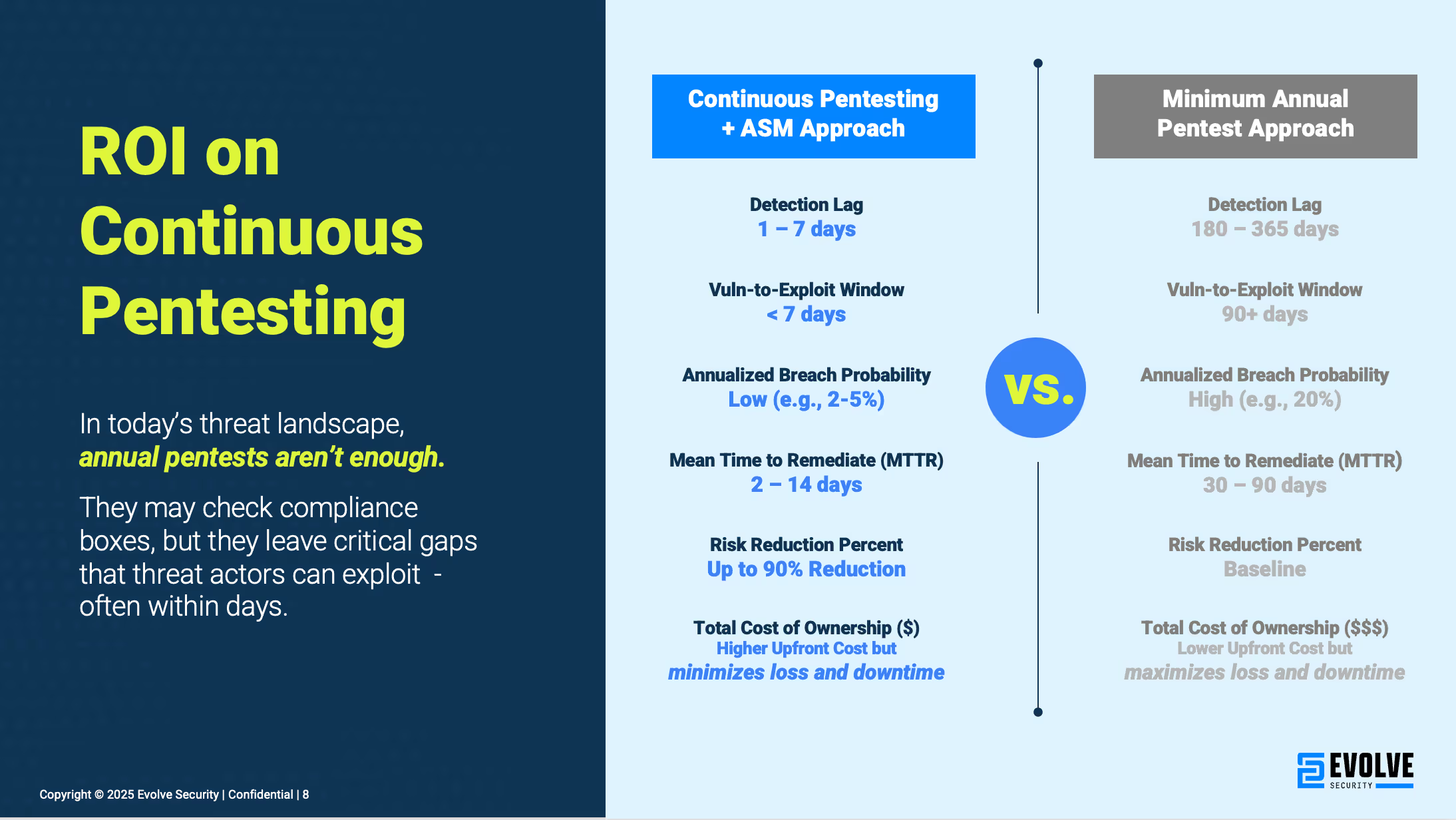
The most compelling ROI of continuous penetration testing is speed specifically, how fast organizations detect, validate, prioritize, and remediate real-world attack paths.
With an annual penetrating test approach:
- Detection lag: 180–365 days
- Vulnerability-to-Exploit window: 90+ days common
- Mean Time to Remediate (MTTR): 30–90 days
- Annualized breach probability: often ~20%
- Risk reduction: near baseline, heavily dependent on one event
These metrics are catastrophically misaligned with reality. Attackers do not need 180 days. They do not even need 30. Many critical vulnerabilities are exploited within 72 hours of becoming public, and misconfigurations are exploited instantly by automated bots.
Continuous penetration testing collapses these windows:
- Detection lag: 1–7 days
- Vulnerability-to-Exploit window: <7 days
- MTTR: 2–14 days
- Annualized breach probability: 2–5%
- Risk reduction: up to 90%
These are not theoretical improvements; they are operational advantages. Continuous penetration testing places teams in a posture of ongoing readiness, alert, empowered, and proactive.
Risk Isn’t Linear—It Compounds
One of the most misunderstood concepts in cybersecurity is how risk behaves over time. Leaders assume that an environment with vulnerabilities is risky in a predictable, stable way. The truth is far more severe: risk compounds like debt.
Every new vulnerability stacks on top of existing ones. Every misconfigured service creates new attack paths. If patching is delayed, attackers discover dependencies, move laterally, and escalate privileges.
A single Java deserialization bug might not trigger a breach on its own, but when paired with weak IAM controls or inadequate API authentication, it becomes an accelerant.
Annual penetration testing essentially allows risk to accumulate uninterrupted. By the time the organization re-tests, it is triaging hundreds of potentially high-impact issues at once. Continuous penetration testing breaks this compounding cycle. Problems are addressed early, when:
- Attack vectors are local, not systemic.
- Remediation effort is smaller.
- Business disruption is lower.
- Exploitation paths are shorter and easier to contain.
This alone delivers massive ROI, one that never shows up on a balance sheet, but profoundly affects operational resilience.
Mean Time to Remediate (MTTR) Is the Silent ROI Engine
CISOs spend endless energy arguing for budget increases, platform upgrades, and new tools. Yet the most decisive ROI lever they control is how fast vulnerabilities get fixed.
MTTR represents the gap between “we know” and “we acted.” Every additional day between discovery and remediation increases the chance of breach, ransomware, insider misuse, and third-party compromise.
Annual penetration testing inflates MTTR because teams are overwhelmed by volume. They receive dozens or hundreds of findings at once, all competing for priority. Engineering teams become defensive and frustrated. Production freezes. Business stakeholders see security as obstruction.
Continuous penetration testing eliminates that bottleneck. Findings are delivered in real time, prioritized, and contextualized. Teams remediate while problems are still manageable. Instead of uprooting hundreds of weaknesses once a year, they fix dozens each month.
This is the difference between emergency response and continuous improvement.
The Economics of Breach Prevention
A major misconception is that continuous penetration testing is expensive. It is not. It is simply priced differently.
Annual penetration testing like car insurance without regular maintenance: you pay a single premium and hope nothing goes wrong. Continuous penetration testing like routine preventative service you invest in ongoing condition monitoring and avoid catastrophic failure.
Breach economics are brutal.
Costs are rarely limited to incident response or forensics. They cascade:
- Lost revenue from service outages
- Reputational damage
- Legal settlements
- Customer churn
- Regulatory penalties
- Business interruption
- Productivity loss
- Executive distraction
- Cyber insurance increases
- Long-term brand erosion
One moderate breach can erase years of penetration testing budgets. Even mild ransomware incidents regularly exceed six and seven-figure recovery costs, often with reputational impacts that never fully heal. The ROI of continuous penetration testing becomes obvious: It minimizes the probability of catastrophic events.
A 90% reduction in breach likelihood is not “nice to have.” It is existential.
The Quiet ROI: Greater Board-Level Trust and Strategic Confidence
Cybersecurity leaders may underestimate the cultural, operational, and strategic benefits of continuous testing. Boards speak the language of risk, probability, and consequence, not CVSS scores. They care about predictability, competitive advantage, and business resilience.
When a CISO presents metrics like:
- Detection cycle: 3–5 days
- Mean Time to Remediate: <10 days
- Attack surface change: monitored weekly
- Exposure window: under one week
Boards see competence. They see control. They see executive maturity. In turn, CISOs gain political capital—budget approvals, staffing increases, product security buy-in, and influence over digital transformation initiatives.
By contrast, organizations that present annual penetration tests results look reactive and fragmented. They talk about last quarter’s vulnerabilities while attackers probe this quarter’s environment.
Continuous penetration testing gives leadership the ability to say:
We know where we’re exposed today—because we test it today.
That confidence is an intangible ROI multiplier.
From Compliance to Continuous Assurance
Compliance-driven security is a race to the bottom. Organizations do the minimum necessary to pass audits and avoid fines, then resume regular operations. Threat actors thrive on these behaviors. When your adversaries know you test once a year, they will simply wait.
Continuous penetration testing transforms compliance into assurance. Instead of proving that you were secure once, you demonstrate:
- Real-time operational discipline
- Evidence of sustained remediation
- Active attack surface monitoring
- Ongoing exposure validation
- Documented reduction in exploitability
Auditors, customers, insurance carriers, investors all appreciate the peace of mind that continuous penetration testing provides. And most importantly, yet attackers hate this.
Operational Simplicity: Security Teams Become Less Reactionary
Annual testing inevitably forces teams into fire-drill mode. All hands on deck, security engineers scrambling, operations teams overwhelmed, project managers juggling remediation deadlines.
Continuous penetration testing distributes the load. Smaller batches of vulnerabilities create a predictable operations cadence. Engineers develop muscle memory. DevSecOps pipelines integrate fixes naturally. Security stops being a crisis and becomes a workflow.
This alone changes culture. Instead of fearing penetration tests, teams welcome them. Instead of scrambling to prioritize fixes, they handle them as they arise. Instead of viewing security as adversarial, technology leaders see it as partnership.
Better Context, Better Decisions, Better Investments
One of the worst outcomes of annual penetration tests is wasted spending. Leaders purchase tools based on failure, not strategy. They buy something after a major incident or audit finding, trying to close a gap in a hurry.
Continuous penetration testing provides a constantly refreshed picture of where risk truly exists. It separates theoretical vulnerabilities from exploitable ones. It highlights systemic problems, weak identity policies, insecure APIs, unmonitored third-party access, long before they are operational disasters.
Executives can invest strategically:
- Strengthening IAM
- Automating patch pipelines
- Modernizing endpoint controls
- Reducing unnecessary attack surface
- Integrating continuous ASM
- Improving segmentation
- Introducing zero trust workflows
Capital flows where it matters most. ROI increases, not because the organization spent less, but because it spent correctly.
The Real Transformation: A Predictable, Managed, Contained Risk Profile
Cybersecurity will never be risk-free. No technology stack is perfect. No company is impenetrable. But organizations can choose whether their risk profile is volatile or controlled.
Annual penetration testing creates volatility. Continuous penetration testing creates manageability.
Volatility is expensive. Manageability is scalable. This is the essence of ROI.
Conclusion: Continuous Penetration Testing Is Not a Luxury, It Is Modern Security
The era of point-in-time testing is over. Attackers move too fast, cloud environments change too frequently, and customer expectations demand higher resilience. Continuous penetration testing with real attack surface monitoring closes the gap between adversary speed and defender readiness.
Its ROI is unmistakable:
- Faster detection
- Shorter exploit windows
- Lower breach probability
- Reduced MTTR
- Lower operational disruption
- Fewer catastrophic incidents
- More strategic decision-making
- Greater organizational trust
- Reduced long-term cost
Yes, it requires more upfront investment. But it prevents the far greater loss of downtime, breach response, and company-wide turmoil. It is not only a security improvement, it is a business advantage.
For organizations that want to be resilient, not just compliant, continuous penetration testing is no longer optional. It is essential.