Network Penetration Testing

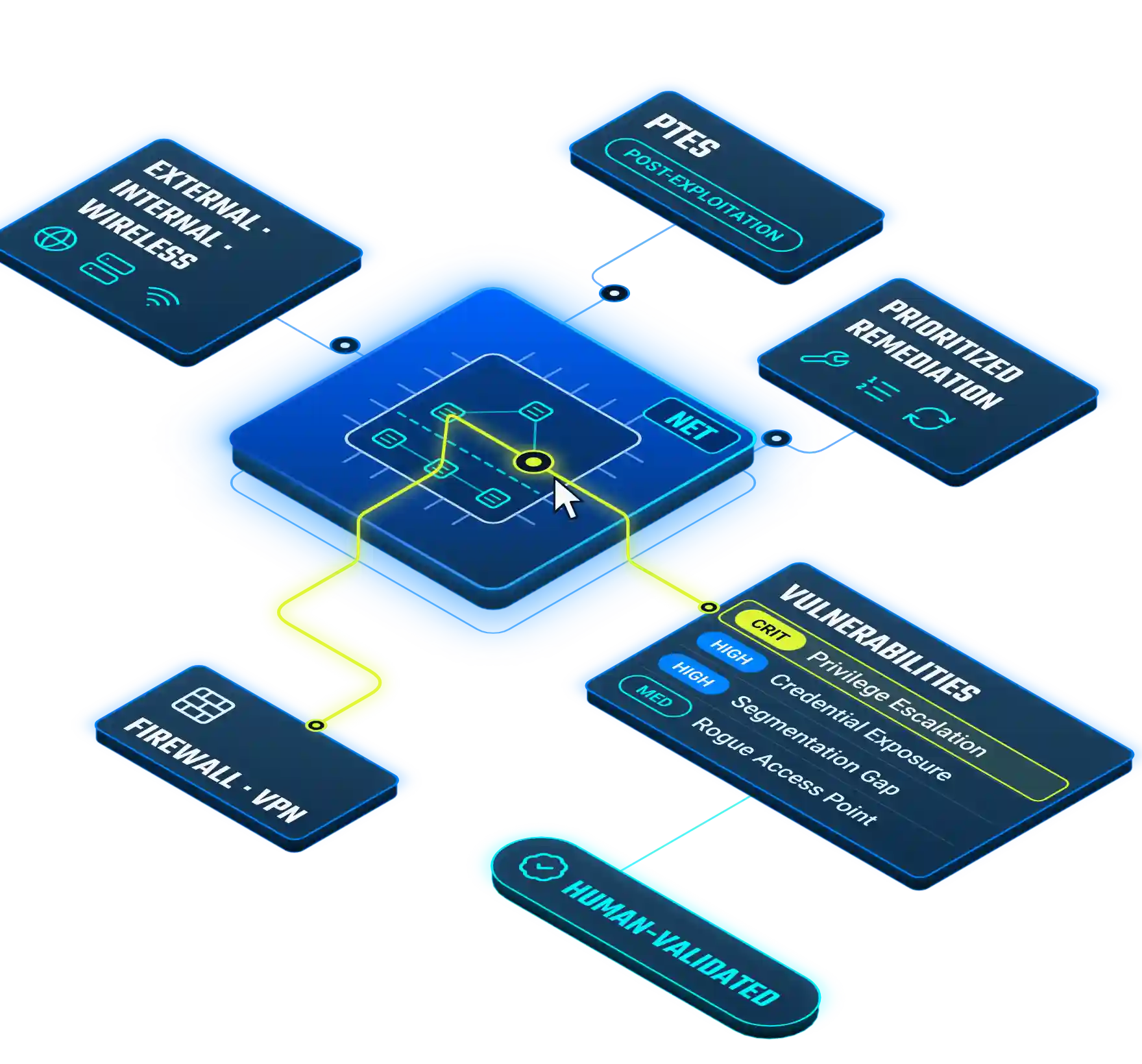
Imagine a network designed to withstand attackers, not assumptions. Our pen testing operators assess networks the way adversaries navigate them, uncovering paths to privilege, lateral movement, and impact. By continuously validating segmentation, access, and detection controls, we help organizations move from perimeter defense to resilient infrastructure.

Network Testing Overview

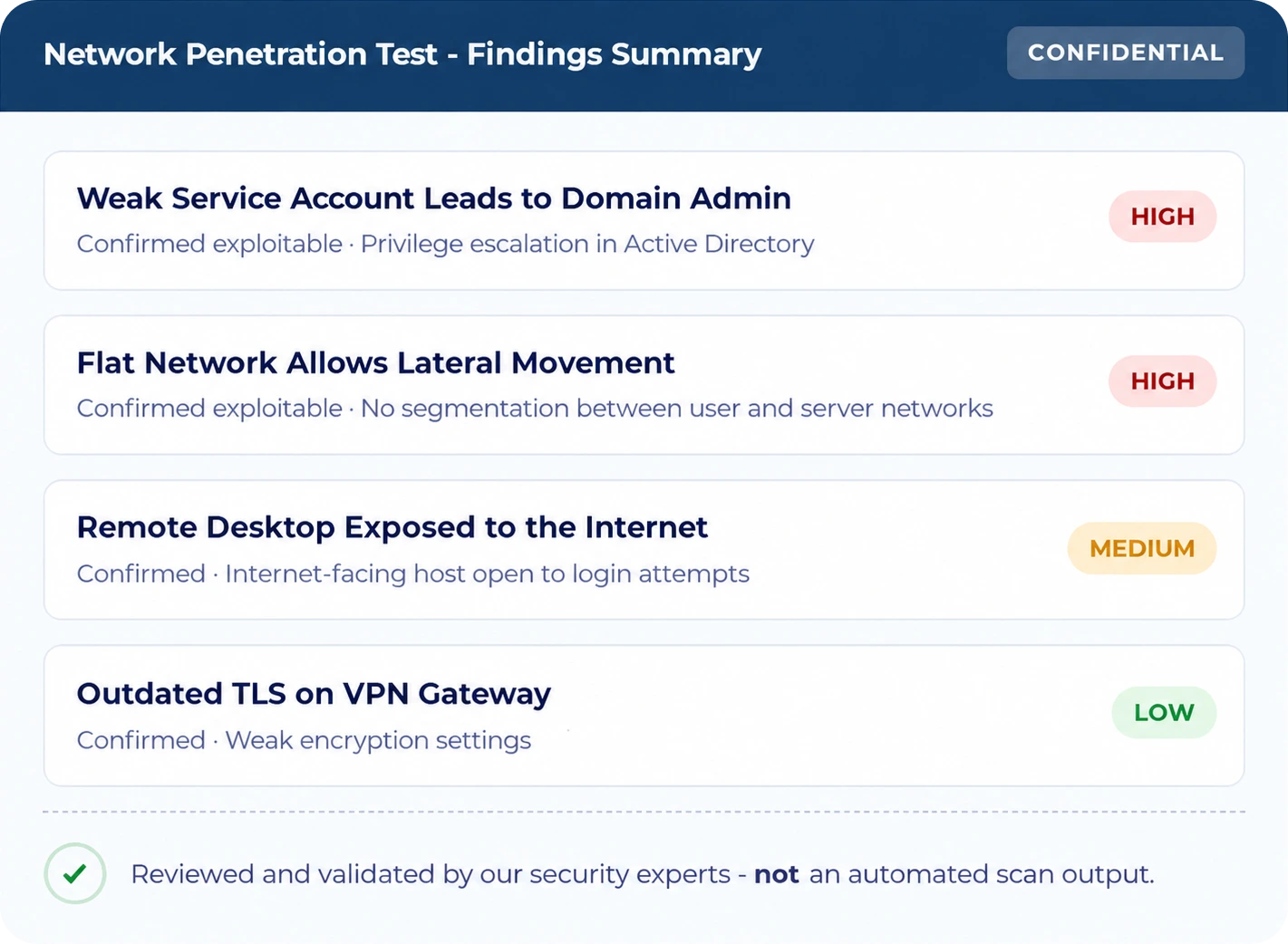
Regular internal and external penetration cycles that combine automated scanning with expert validation to uncover lateral-movement paths, misconfigurations, and exploitable hosts.

External Penetration Testing

Continuously test internet-facing systems to identify exploitable weaknesses before attackers can access them.

Methodology:

  • Identify exposed assets, services, and attack surfaces
  • Test perimeter defenses, firewalls, VPNs, and edge controls
  • Assess web services, APIs, and network entry points
  • Simulate real-world external attacker techniques
  • Deliver prioritized remediation based on exploitability and impact

Internal Security Assessment

Continuously evaluate internal network security to identify lateral movement, privilege escalation, and access risks.

Methodology:

  • Assess internal segmentation, trust relationships, and access controls
  • Test credential exposure and privilege escalation paths
  • Evaluate endpoint, directory, and authentication weaknesses
  • Simulate insider and post-compromise attack scenarios
  • Provide risk-ranked findings with actionable remediation

Wireless Penetration Testing

Continuously test wireless networks to identify exploitable weaknesses, rogue access points, and unauthorized access risks.

Methodology:

  • Discover and analyze wireless networks, SSIDs, and access points
  • Test encryption, authentication, and key management controls
  • Identify rogue, evil twin, and misconfigured access points
  • Assess client device security and wireless segmentation
  • Deliver prioritized remediation aligned to industry best practices

Advanced Testing (Assumed Breach)

Simulate post-breach scenarios to test detection, response, and resilience against advanced adversary behavior.

Methodology:

  • Assume initial access and execute scenario-based attack paths
  • Test lateral movement, persistence, and data exfiltration techniques
  • Evaluate security monitoring, alerting, and response effectiveness
  • Measure time-to-detection and containment gaps
  • Deliver executive-ready findings with operational improvement guidance

External Penetration Testing

Continuously test internet-facing systems to identify exploitable weaknesses before attackers can access them.

Methodology:

  • Identify exposed assets, services, and attack surfaces
  • Test perimeter defenses, firewalls, VPNs, and edge controls
  • Assess web services, APIs, and network entry points
  • Simulate real-world external attacker techniques
  • Deliver prioritized remediation based on exploitability and impact

Internal Security Assessment

Continuously evaluate internal network security to identify lateral movement, privilege escalation, and access risks.

Methodology:

  • Assess internal segmentation, trust relationships, and access controls
  • Test credential exposure and privilege escalation paths
  • Evaluate endpoint, directory, and authentication weaknesses
  • Simulate insider and post-compromise attack scenarios
  • Provide risk-ranked findings with actionable remediation

Wireless Penetration Testing

Continuously test wireless networks to identify exploitable weaknesses, rogue access points, and unauthorized access risks.

Methodology:

  • Discover and analyze wireless networks, SSIDs, and access points
  • Test encryption, authentication, and key management controls
  • Identify rogue, evil twin, and misconfigured access points
  • Assess client device security and wireless segmentation
  • Deliver prioritized remediation aligned to industry best practices

Advanced Testing (Assumed Breach)

Simulate post-breach scenarios to test detection, response, and resilience against advanced adversary behavior.

Methodology:

  • Assume initial access and execute scenario-based attack paths
  • Test lateral movement, persistence, and data exfiltration techniques
  • Evaluate security monitoring, alerting, and response effectiveness
  • Measure time-to-detection and containment gaps
  • Deliver executive-ready findings with operational improvement guidance

External Penetration Testing

Continuously test internet-facing systems to identify exploitable weaknesses before attackers can access them.

Methodology:

  • Identify exposed assets, services, and attack surfaces
  • Test perimeter defenses, firewalls, VPNs, and edge controls
  • Assess web services, APIs, and network entry points
  • Simulate real-world external attacker techniques
  • Deliver prioritized remediation based on exploitability and impact

Internal Security Assessment

Continuously evaluate internal network security to identify lateral movement, privilege escalation, and access risks.

Methodology:

  • Assess internal segmentation, trust relationships, and access controls
  • Test credential exposure and privilege escalation paths
  • Evaluate endpoint, directory, and authentication weaknesses
  • Simulate insider and post-compromise attack scenarios
  • Provide risk-ranked findings with actionable remediation

Wireless Penetration Testing

Continuously test wireless networks to identify exploitable weaknesses, rogue access points, and unauthorized access risks.

Methodology:

  • Discover and analyze wireless networks, SSIDs, and access points
  • Test encryption, authentication, and key management controls
  • Identify rogue, evil twin, and misconfigured access points
  • Assess client device security and wireless segmentation
  • Deliver prioritized remediation aligned to industry best practices

Advanced Testing (Assumed Breach)

Simulate post-breach scenarios to test detection, response, and resilience against advanced adversary behavior.

Methodology:

  • Assume initial access and execute scenario-based attack paths
  • Test lateral movement, persistence, and data exfiltration techniques
  • Evaluate security monitoring, alerting, and response effectiveness
  • Measure time-to-detection and containment gaps
  • Deliver executive-ready findings with operational improvement guidance

Powered By Our Darwin Attack Platform

WHAT TO EXPECT?

Onboarding Platform

1

Align Objectives & Outcomes

2

Ongoing Testing / PIT Testing

3

Quarterly Service Review

4

Ongoing Testing Dashboard

5

Why Evolve Security?

01

CTEM Maturity Model

Evaluate CTEM maturity and strengthen resilience by assessing readiness against evolving adversary techniques and attack vectors.

02

CPT Market Leader

Offensive SOC and engineering experts drive measurable outcomes, guiding every phase from exposure discovery to remediation.

03

Award Winning Platform

Darwin Attack platform validates security controls and precisely pinpoints prioritized vulnerabilities across dynamic environments.

04

OffSec Operations Center (OSOC)

Agile bullpen of offensive testers rapidly adapts tactics, mirroring adversaries as threats and business priorities shift.

05

Trusted Methodologies

Industry-trusted methodologies including OWASP, OSSTMM, PTES, and NIST ensure disciplined, comprehensive penetration testing rigor.

06

Customized Simulations

Tailored simulations reflect an industry’s distinct threats, adversary behaviors, and mission-critical attack scenarios.

Game Changing Resources

Dive into our game changing resource library that delivers novel thought leadership and real-time perspectives that reimagine how organizations design, manage and elevate offensive security programs

Legacy Pentesting Couldn't Keep Up With an LLM-Powered Investment Platform. Here's What Replaced It.

Quarterly pentests couldn't keep pace with an LLM-powered investment platform. See how continuous penetration testing closed the gap, with critical vulnerabilities validated in 24 hours, not months.

Evolve Security Named to Momentum Cyber's 2026 Cybersecurity Services Market Report

Evolve Security has been selected as one of 20 cybersecurity services firms featured in Momentum Cyber's 2026 Market Report, chosen from more than 15,000 firms across the United States.

Rob Tincher, Application Security Manager, OPENLANE

OPENLANE, a leading digital marketplace for wholesale vehicles, partners with Evolve Security to managed its advanced offensive security program.

Scott Howitt, CEO, SVH Cyber

Scott Howitt explains why Continuous Penetration Testing is essential amid AI-driven threats, highlighting measurable risk reduction, resilience, and stronger business-aligned security outcomes.

Black Hat & Def Con 2026

Las Vegas

Zafran | 2026 - Private Happy Hour

Uchiko, Plano, Texas

Is Anybody Safe? Adaptability in the Age of AI Disruption - with Mark Carney

Is any security company safe from AI disruption? Evolve Security CEO Mark Carney's answer: no and that's the wrong question anyway.

Pen Testing in the Age of AI: Man + Machine w/ Paul Petefish

AI is changing security fast. But is it replacing pentesters, or just giving them a powerful new co-pilot?