Legacy Pentesting Couldn't Keep Up With an LLM-Powered Investment Platform. Here's What Replaced It.

CASE STUDY
Securing Homegrown Apps & LLMs with Continuous Penetration Testing and Threat Modeling
A private equity firm built its edge on proprietary applications and LLMs that analysts rely on to make investing decisions. That edge was also an exposure. No mature security standard covered it, and the gap between deploying new AI-driven capability and validating its security kept the firm one bad prompt away from a costly mistake.
Client Profile
The client is a private equity firm that provides flexible capital solutions to growth-oriented companies. Its portfolio spans software, digital infrastructure, healthcare IT, financial technology and services, and business services, sectors where the firm's own technology stack has to move as fast as the markets it evaluates.
The Challenge
The client came to Evolve Security looking for guidance on securing the core applications and LLMs that power its analysts' investment decisions. Without mature standards or governance frameworks in place, the internal team was left experimenting with ad-hoc defenses instead of consistent protections, a gap that grows more dangerous as LLM adoption accelerates and adversaries adapt just as fast.
As threats against these assets escalated, the client needed more than a one-time assessment. It needed an initial threat model paired with continuous offensive pressure against its infrastructure, a program that would find exposure before an adversary did, not after.
Solutions & Outcomes
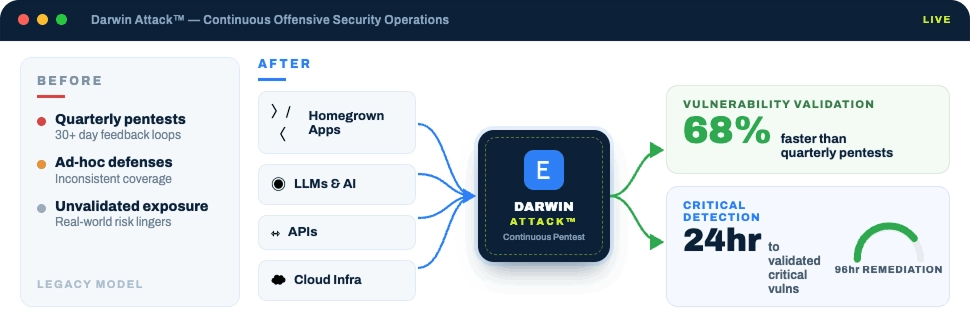
Evolve transitioned the client from point-in-time testing to a true continuous penetration testing model, powered by Darwin Attack®. Instead of a single snapshot every quarter, the client now has ongoing adversarial testing and human-in-the-loop validation working against its applications and LLMs every day.
The results:
- 68% faster vulnerability validation compared to the client's previous quarterly pentest cadence.
- 96-hour average remediation feedback loops, down from 30+ days under the legacy testing cycle.
- Critical vulnerabilities identified and validated within 24 hours of exposure going live, closing the window attackers rely on before it could be exploited.
Why It Matters
A quarterly pentest tells you what your attack surface looked like months ago. For a firm shipping new LLM capability on an ongoing basis, that's not security, it's a snapshot with an expiration date.
Continuous penetration testing closed that gap: exposure gets found and validated within hours of going live, not discovered in the next scheduled assessment.
This is the model Evolve Security builds for every client operating homegrown applications and AI systems where the pace of development has outrun the pace of legacy security review. Automated discovery runs continuously; the Offensive SOC (OSOC) validates every finding; remediation happens in days, not months.
Are you ready to evolve your approach to securing what you're building?